


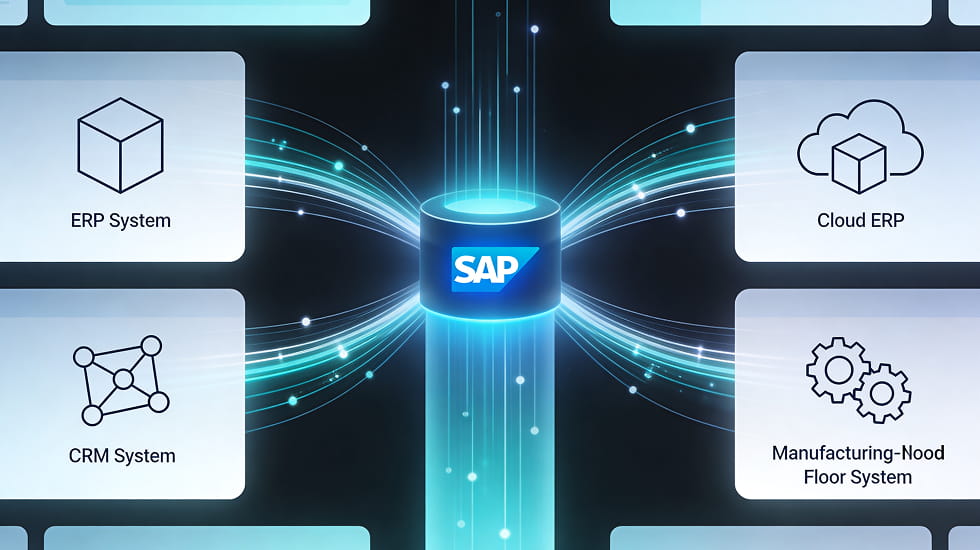
In today’s business environment, data is everywhere—sales transactions, customer interactions, production numbers, financial reports. The challenge is not the lack of data, but making sense of it quickly and reliably. This is where SAP BW/4HANA comes in.
SAP BW/4HANA is a modern data warehousing solution designed to bring data from different systems into one trusted place and turn it into meaningful business insights. Think of it as a central library for business data—clean, organised, and always up to date—built on SAP’s high-speed HANA platform.
Unlike older data warehouses that were slow and complex, BW/4HANA is faster, simpler, and designed for real-time decision-making.
SAP BW/4HANA is ideal for:
- Business leaders and CFOs who want one version of the truth
- Operations and supply chain heads tracking performance across plants or locations
- Sales and marketing leaders analysing trends, margins, and customer behaviour
- Growing organisations dealing with data spread across ERP, CRM, spreadsheets, and external systems
With SAP BW/4HANA:
- All data flows into one central warehouse
- Sales, production, inventory, and finance are linked
- The CFO can instantly see profitability by product, plant, or customer
- Leaders can spot delays, cost overruns, or margin erosion early—not after the quarter ends
At a business level, BW/4HANA delivers three outcomes:
1. Consistency – Everyone sees the same numbers, defined the same way
2. Speed – Reports that once took days are available almost instantly
3. Confidence – Leaders spend time acting on insights, not debating data accuracy
SAP BW/4HANA is not about technology—it is about clarity, speed, and confidence in decision-making. For organisations navigating growth, complexity, and data overload, it provides a strong foundation to turn data into actionable insight—without overwhelming the business user.
In a world where decisions need to be faster and smarter, SAP BW/4HANA quietly becomes the backbone that makes that possible.
Let us explore this with an example – An organisation that has
- India entity running on SAP Business One
- Europe entity running on SAP S/4HANA Public Cloud
- Sales managed on Salesforce
- Production data coming from a shop-floor / MES system
- Leadership wants one consolidated view of the business
Each system works well on its own, but the leadership faces some real issues:
- India revenue ≠ Europe revenue (different charts of accounts, currencies, structures)
- Salesforce shows bookings, ERP shows invoicing—numbers don’t match
- Production efficiency is discussed separately from financial impact
- Month-end reviews turn into reconciliation meetings, not decision meetings
Everyone has data, but not necessarily the full picture.
SAP BW/4HANA sits above all these systems as a central business intelligence layer. Think of it as a neutral meeting room where all data is:
- Brought together
- Cleaned and standardised
- Made comparable
- Stored historically
It does not replace any system:
The data flows (conceptually)
1. SAP Business One (India)
- Financials, customers, products, inventory
- IData extracted periodically or in near real time
- Finance, logistics, controlling
- Pulled via standard APIs and interfaces
- Leads, opportunities, order bookings
- Integrated to analyse pipeline vs actual revenue
- Production output, downtime, scrap, efficiency
- Connected to show operational reality behind the numbers
All of this flows into BW/4HANA, where data is:
- Converted into common definitions(What is “revenue”? What is a “customer”? What is a “plant”?)
- Aligned across currencies, time zones, and entities
Now, Instead of four systems, leaders see one dashboard:
- Group revenue: India + Europe (same definitions)
- Sales pipeline (Salesforce) vs billed revenue (ERP)
- Production efficiency vs cost impact
- Margin by product, region, and customer
- Trends across months, quarters, and years
No Excel stitching. No manual reconciliation. The conversation shifts from “Are these numbers right?” to “What should we do next?”We also need to know that SAP BW/4HANA is not tied to any single ERP. It can work with:
- SAP Business One
- SAP S/4HANA (both Public and Private Cloud)
- Legacy SAP systems
- Non-SAP systems such as CRMs, manufacturing systems, and even Excel files
BW/4HANA sits above these systems, consolidating data rather than replacing anything.SAP Business One customers typically don’t need BW/4HANA on day one. But as the business scales, adds entities, or introduces more systems, BW/4HANA becomes a powerful next step
